
To quote an article in an essay, introduce the source with a signal phrase, place the exact words in quotation marks, and add an in-text citation.
The format varies by style — APA uses (Author, Year), MLA uses (Author Page), Chicago uses footnotes.
Dropping a quote without context is one of the most common mistakes.
Quoting articles correctly can make your essay stronger, more credible, and better supported by evidence. Still, many students don’t know how to quote an article in an essay or which citation format to use.
The sections below cover 7 strategies for smooth transitions, punctuation rules, and how citation formats differ.
- To cite correctly, introduce the source with a signal phrase, place the exact words in quotation marks, and add an in-text citation.
- The format varies by style: APA uses (Author, Year), MLA uses (Author, Page), and Chicago uses footnotes.
- Dropping a citation without context is one of the most common mistakes.
7 Strategies for a Smooth Transition into Quotations
Understanding how to properly cite a source is crucial in the academic environment. The citation in the essay is like a unique ingredient in your favorite meal.
However, simply putting them in is insufficient. You must do things so that everything flows smoothly.
There are a few ways to start a citation. Let’s have a look at some of them.
1. Direct introduction
When you put quotes in an essay, simply state the source and introduce it directly.
For example, you could say,
2. Signal phrases
Use signal phrases to attribute the quote to its source: “According to,” “As [author] argues,” or “In the words of.”
For instance:
3. Contextualization
Give a little background before you embed a quote:
This is one of the strongest quoting examples of how a quotation can be smoothly integrated into writing.
4. Setting the scene
Sometimes, you want to create a picture before dropping the embedded quotation. Set the stage for the quote by describing the situation or background.
For instance:
5. Contrasting views
This is like giving the other side an opinion or argument.
One could say,
6. Interjecting commentary
Provide a remark or analysis before or after it.
For example:
7. Question or challenge
Create curiosity or stimulate thought.
Ask a question before dropping the quote:
Knowing the steps to quote a poem in an academic essay allows you to correctly use these strategies and to be clear when working with literary sources. Let’s move to these rules and more tips!
Maintain the Flow of Your Writing When Using Quotations
Using quotes in your work should be simple. But problems often occur when quotes are inserted without a clear purpose or context.
Understanding how to reference an article in an essay allows you to comply with the citation rules and to maintain the flow and readability of your writing.
Follow the recommendations below to keep your logic and flow strong:
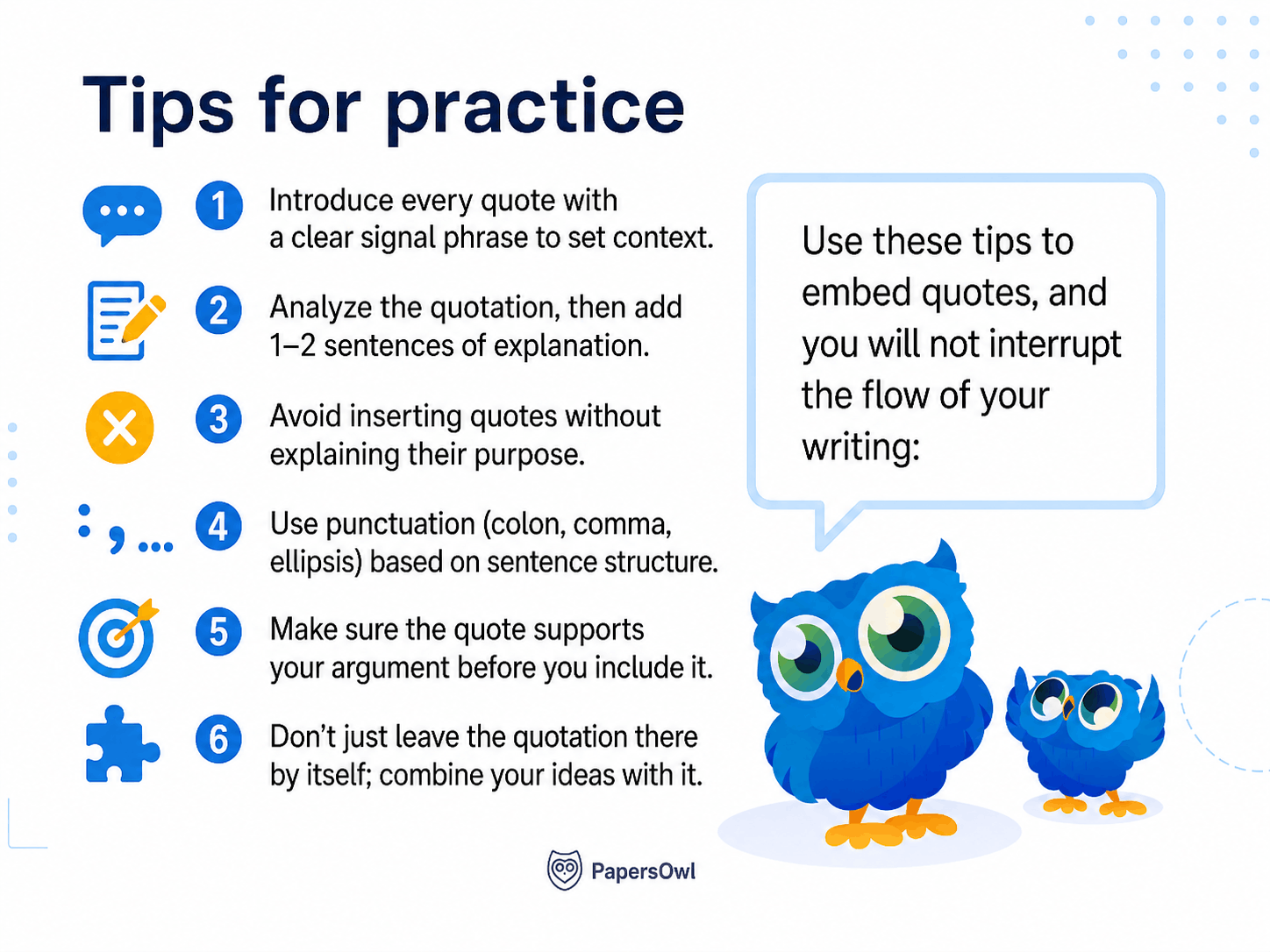
- Always introduce the quote and explain why it matters. Lead the reader into a quote with signal phrases such as the author explains, the research shows, or according to the text. This avoids “quote dropping,” where a quote is just dropped in with no connection to your argument.
- Never let a quote stand without interpretation. Another important practice is to integrate your analysis into the quoted material. With each quotation, explain how it supports your point. This will help to prevent a breach of logic, where the essay drops from your argument to someone else’s idea without explanation or connection.
- Use punctuation well — colons, commas, or ellipses. It will make the quotes flow smoothly into your sentence structure. A colon is good to introduce a quote that is a full sentence, for example. For short embedded phrases, commas are better.
- Always verify the credibility and relevance of your source. Strong essays use quotes that support the argument, not those that interrupt it. Used properly, quotations do not undermine your reasoning. Instead, they improve clarity and buttress your reasoning.
So, citing a quote from a book is not just something you do in an essay. It’s a matter of introducing it in a way that fits seamlessly into your writing.
If you need more information on the subject, I have an idea. PapersOwl’s essay assistance is an excellent option to go deeper into the subject without losing your academic mind.
Proper Use of Punctuation with Quotations
Punctuation within quotations is crucial. We use quotation marks to set off quotes in an essay, which look like these: “”.
If you use punctuation incorrectly, it may cause severe grammatical trouble.
That’s why I give these 2 easy-to-remember punctuation rules to learn how to cite sources in an essay:
- Periods outside of quotes are a common mistake you can see. Still, in American English, commas and periods typically go inside quotation marks. Colons and semicolons go outside.
- Question marks and exclamation points vary based on context. Use a question mark or an exclamation point within the closing quotation marks if the punctuation is related to the citation itself. If the punctuation applies to the entire sentence, place it outside the closing quotation marks to end a quote.
Example of a quote in an essay:
- She said, “Hello.”
- He said, “I may forget your name, but I never forget a face.”
- Marco asked, “Do you need this pen?”.
There are also single quotation marks in American English. Do not confuse them, as they are exclusively used for adding a quote within a quote:
Impact of Formatting Quotations
Formatting quotations can enhance the overall visual appeal of your essay.
When organizing information, bullet list formatting in essay writing can also help create clarity and structure, especially when listing multiple points or examples.
Consider using formatting elements, such as italics or bold, for emphasis. Additionally, experiment with indentation and spacing to achieve a neat, organized appearance.
Let’s compare two quotes in essays. The examples will help illustrate the impact of formatting.
- In J.K. Rowling’s “Harry Potter and the Sorcerer’s Stone,” Dumbledore imparts wisdom: “It takes a great deal of bravery to stand up to our enemies, but just as much to stand up to our friends.”
- In “Harry Potter and the Sorcerer’s Stone,” Dumbledore says, “It takes a great deal of bravery to stand up to our enemies, but just as much to stand up to our friends”.
The first quote is more appealing and draws the reader’s attention. Meanwhile, the second one has punctuation mistakes and may be lost in the text.
An effective way to present information is to use a quote in an essay. Besides, it can visually engage your readers.
Here’s How to Cite Your Work in Various Citation Styles
In PapersOwl, we have already covered citation rules. However, we would like to discuss it here, as it will help us explain a quote in an essay.
It is essential to mention the same author’s sources wherever possible.
References serve as direct indicators for whatever information you are employing. Citing sources shows readers that a piece of information in your work is not your own.
The most popular citation styles are APA, MLA, and Chicago.
APA
In APA format for the paper, we cite the author’s last name and the publication year in parentheses.
According to recent studies, sleep patterns significantly impact cognitive function (Johnson, 2020).
Let’s see the essential rules for this formatting style.
| Rule | Explanation | Example |
|---|---|---|
| Include author + year | Always add the author’s last name and year in parentheses | (Johnson, 2020) |
| Use signal phrases | Introduce quotes with phrases like “According to…” | According to Johnson (2020)… |
| Add page number for direct quotes | Required when quoting exact words | (Johnson, 2020, p. 15) |
| Keep quotes short | Use brief quotations and explain them | “Sleep improves memory” (Johnson, 2020, p. 15) |
| Integrate analysis | Always explain the quote after using it | — |
MLA
When citing in an essay in MLA style, we indicate the author’s name and page number, e.g., (Jones 45).
The novel explores themes of identity and self-discovery (Doe 72).
| Rule | Explanation | Example |
|---|---|---|
| Include author + page number | No comma between author and page | (Doe 72) |
| Use signal phrases | Introduce the author before quoting | Doe argues that… |
| Use quotation marks | Always place exact words in quotes | “Identity shapes behavior” (Doe 72) |
| Page number is required | Even if the year is not included | (Jones 45) |
| Blend the quote with the sentence | Avoid isolated quotations | — |
Chicago
In Chicago style, citations can be either footnotes or endnotes. A full citation is added to the bibliography.
The economic implications of globalization are vast and multifaceted.¹
¹Smith, John. Globalization and Its Effects. Chicago: University Press, 2018.
| Rule | Explanation | Example |
|---|---|---|
| Use footnotes or endnotes | Citations appear as notes, not in-text | ¹ |
| Provide full source in notes | First citation includes full details | ¹Smith, Book Title |
| Use quotation marks for direct quotes | Exact words must be clearly marked | “Globalization changes markets.”¹ |
| Include bibliography | Full list of sources at the end | Bibliography entry required |
| Keep quotes supported by notes | Every quote must have a reference | — |
To better understand the key differences between these styles, let’s compare their main features side by side.
Comparison of citation styles: quick table
| Style | In-text citation format | Key feature | Full reference style | Example |
|---|---|---|---|---|
| APA | (Author, Year) | Focus on publication date and currency | Reference list at the end of the paper | (Johnson, 2020) |
| MLA | (Author Page) | Focus on the page number and text location | Works Cited page | (Doe 72) |
| Chicago | Footnotes or endnotes | Uses notes + bibliography system | Bibliography + footnotes | ¹Smith, John. Book Title |
In-text citation vs. bibliography: what’s the difference?
- In-text references appear directly in the body of the essay. They show where specific ideas or information come from and help readers follow your argument.
- The bibliography appears at the end of the paper and includes full details of every source used.
- While in-text references point to a specific idea, the bibliography provides complete publication information for each source in one organized list.
Can citations be confusing in the modern world? Not anymore!
Now, you can check your references and citations in the citation generator online. It will help you write an outstanding text with flawless quotes and citations.
6 Tips on Embedding Quotations in an Essay
You should also understand how to make a citation naturally. You can not just put a paragraph from the book you’d read. Here are some tips:
- Start a quote with an active verb. To use quotes in a text seamlessly, begin with an active verb. Use them to enhance subtlety and successfully communicate the speaker’s tone.
- Use a descriptive verb. Incorporate descriptive verbs to increase the impact of your quotations. These verbs provide depth to your quotations and fill your story with context.
- Select proper quotations. Add quotes in an essay that are relevant to your topic and give useful information. Moreover, make sure your quotes are brief and clearly support your views. Make relevance, trustworthiness, and clarity your top priorities.
- Try to paraphrase long quotes. When dealing with lengthy quotes, try paraphrasing them to achieve a more concise integration. This ensures that you understand how to write quotes in an essay and explain them in your own words. At the same time, be careful not to change the meaning of the quote!
- Don’t overuse quotes. Overusing quotes is a sign to your teacher that you don’t know how to paraphrase well. How many quotes per paragraph you should use depends on the length of your work. I recommend using one quote for every five paragraphs. The perfect approximate amount looks like this:
- 2 quotes for a 1500-word paper;
- 3 quotes for a 2000-word paper;
- 4 quotes for a 3000-word paper.
How to Start an Essay with a Quote?
To start a paper with a quote, you must choose one that brings up the proper tone of your paper. The quotation source must be credible and fit your essay context.
Learning how to correctly cite a source is essential for academic accuracy and helps maintain trust in your arguments. Finally, each phrase you pick must support your assertion while demonstrating your case proficiency.
All of that is important because the purpose of quotes is to make a good hook for an essay and grab the attention of your target audience, which happens via knowledge and trust.
- Free unlimited checks
- All common file formats
- Accurate results
- Intuitive interface

Using a quote as a hook: when and why?
Use attention-grabbing quotes that are relevant to your topic.
Many great essay examples written by PapersOwl specialists are proof of that. These experts know how to make quotes a powerful tool to engage readers. Taking into consideration their experience, I will provide you with examples of when you could use one:
- When introducing a new topic or a newly found case. A good quotation will show relevance in such situations. It will gain people’s attention while showcasing new topics and establishing their importance.
- If you are in the writing process of a historical essay. In such situations, any quotation from any case-related historical figure may provide context and spark interest in readers.
- Personal experience. For such essays, quotations can grab one’s audience and serve as proof of your experience with this case. They show your perspective and add nuance to your arguments. It affects those reading your paper.
- To support the written arguments’ main point. It’s an outstanding way to start by hooking all readers up while backing up your claims.
- When challenging their beliefs. This is perfect for argumentative essays, where you have to challenge their commonly held view. Such quotations engage people, make them think, and make them eager to read more.
Using a quote relevant to your case is necessary, so always ensure you use a proper one that creates parallels between all sections.
If you don’t see a clear connection, you can get help from experts who edit essay thesis statements. PapersOwl editors can improve your text flow, rework weak statements, and add stronger quotations for your introduction.
They can also check source credibility, topic relevance, and whether each source supports your claim or creates useful controversy.
Fine-Tuning Your Quotation Skills
In summary, quotations are an important addition to your accurate academic essay. They improve your text and help you understand more about the subject of your paper.
Know how to cite an article in an essay as it is essential for academic accuracy and proper source use. Thanks to this guide, you can now easily embed any type of quote into your academic work!