
A good personal narrative essay is usually based on a real experience. It should start with a specific scene, be rich in detail, and end with a clear insight.
- Select a meaningful personal experience.
- Start with a specific moment.
- Write in the first person.
- Add sensory details.
- Follow a clear structure.
- Conclude with reflection and insight.
Knowing how to write a narrative essay is a must for your success in studies. But many students are stressed over choosing the right topic, organizing events, and explaining the lesson behind their story.
Let’s talk about how to create a narrative essay, choose an interesting topic, and write a story that will keep readers interested!
What Is a Narrative Essay?
This is not like many academic essays, where you write from your own point of view and share thoughts, feelings, and lessons learned. Most essays are thus written in the first person with “I” and “my.” They are usually presented in chronological order and focus on a single major event or experience.
The aim is NOT just to describe events. Good narrative writing tells why they were important or how they impacted you. Readers need to be told what happened and why it mattered.
When creating this text, you are the narrator, recalling past experiences or discussing future plans. It may also describe a hypothetical case.
College narrative essay examples
This writing can cover many topics from everyday life:
- The day you moved to a new city.
- A difficult challenge you overcame.
- Your first job interview.
- A memorable family vacation.
- A mistake that taught you a valuable lesson.
- A moment when your worldview changed.
- An achievement you worked hard to get.
General Uses of Narrative Essays
What is narrative writing for students? In academic settings, it is used for a number of reasons:
- For class assignments: Teachers often ask students to write narrative essays based on specific prompts.
- Eligibility for awards: Students may be asked by schools to complete these tasks to demonstrate why they deserve an award. A student nominated for a leadership award, for example, might describe their role in a community project.
- For scholarships: Scholarship committees often ask for narrative essays that demonstrate students’ dedication to a discipline and their future plans.
A good narrative text should have a clear structure, a good story, and respect the standard guidelines. It is important to be inspired, to know the teacher’s specific requirements, and to adhere to them strictly. Add personal insights and unique experiences to make the essay more engaging.
If you do not have the time or inspiration for these detailed personal tasks, you can always pay for an essay to be written by a professional storyteller.
Pros of Narrative Writing
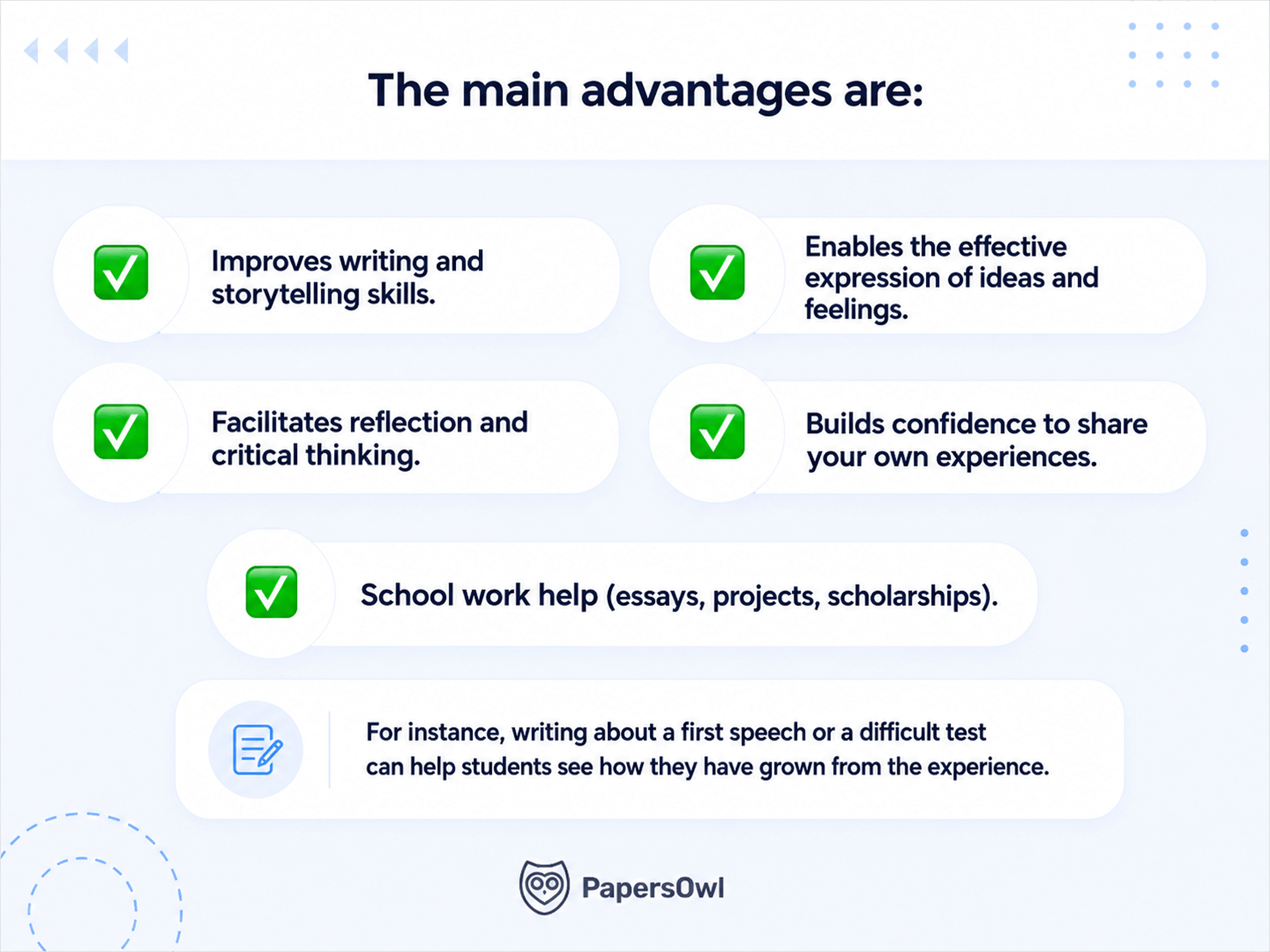
Writing narratives is beneficial for students because it allows them to write about their real-life experiences in a simple, clear way.
It also helps them to better organize ideas, describe events, and explain what they learned from different situations.
Over time, it helps them think more deeply about their own experiences and express them more clearly.
Personal vs. Academic Narrative Essays
Both are kinds of storytelling based on experience. But they serve for different reasons.
| Feature | Personal Narrative | Academic Narrative |
|---|---|---|
| Purpose | Self-expression and reflection | Meet academic requirements and tell a story |
| Focus | Personal experiences and emotions | Personal experiences with analysis and clear lessons |
| Structure | More flexible | Follows a clear essay structure |
| Writing Style | Informal or conversational | More formal and organized |
| Main Goal | Share a meaningful experience | Demonstrate storytelling and writing skills |
| Example | “When I volunteered at an animal shelter for the first time, I realized how much I loved helping others.” | “My science fair project failed on presentation day, but the experience taught me the importance of preparation and problem-solving.” |
So, personal narratives are about self-expression; academic texts are about structure, analysis, and writing skills.
Narrative Essay vs. Short Story
A narrative essay and a short story may look similar because both tell a story. However, they serve different purposes and follow different rules.
- A narrative essay is commonly written for academic tasks and is based on real experiences.
- A short story is usually fictional and allows full creative freedom.
In narrative writing, authors must stay factual and clear. They tend to follow a standard narrative essay structure and are within word limits. They also include a thesis statement that establishes the main idea early in the introduction.
A short story does not require a thesis. Its structure is flexible, and the writer can shape events freely.
The writing style is also different.
Narrative essays tend to be more reflective and clear, whereas short stories tend to be more creative with language and narrative techniques.
| Feature | Narrative Essay | Short Story |
|---|---|---|
| Purpose | Academic or personal reflection | Entertainment or creative expression |
| Content | Often based on real experiences | Usually fully fictional |
| Structure | Clear and organized | Flexible and creative |
| Thesis Statement | Often required in the introduction | Not required |
| Writing Style | Clear, reflective, and focused on meaning | Creative, descriptive, and imaginative |
| Rules | Must follow guidelines and word limits | No strict rules |
| Focus | Explaining meaning and lessons | Building plot and characters |
Choosing a strong personal narrative idea matters, too.
Writing the essay can be difficult if you have a weak, boring personal experience. Short stories, on the other hand, can reach into the imagination, even if there’s no real-life link.
3 Common Narrative Essay Types
There are multiple types of narrative essays. You’ll find some of them below:
- Factual. When writing a factual (or nonfiction) narrative essay, you retell real-life events for others. You’ll look at evidence from one or more sources to put the story together.
- Fictional. For fictional narrative essays, you can be creative and develop any story you want. Since it’s for an academic assignment, it should still serve a purpose and have meaning.
- Autobiographical. An autobiographical essay involves writing down a story you’re directly involved in. This is a factual piece of academic writing where you’re sharing with the reader something you’ve experienced. If you want, you can use the first person and inject your telling of the story with thoughts and opinions.
Most college and university assignments require your work to be factual. Your work will be fictional for some courses only, such as creative writing.
5 Narrative Writing Approaches to Consider in Your Essay
When thinking of how to write a personal narrative essay, you should decide which narrative style or structure fits your story best.
Below are some approaches to consider:
- Linear. When taking a linear approach to the writing, you’ll describe the story’s events in the order they happened. One event will follow the previous one and lead into the next.
- Non-linear. Should you take a non-linear approach, you’ll tell the story’s events out of sequence. This may include flashbacks or even flashforwards.
- Quest. Some stories are sequences of events and characters reacting to them. Others are more like a quest, where a person actively tries to achieve a goal that becomes their entire purpose.
- Viewpoint. In a viewpoint narration, the main character narrates the events from their perspective. The story is not only about the plot. It also shows the narrator’s opinions, ideas, and feelings.
- Descriptive. For this type of narrative writing, you should be very descriptive and use vivid details. Readers should be able to picture the story’s setting and visualize the characters.
Your story should make sense, no matter which narrative approach you choose. The paragraphs should connect in a clear and logical way.
If you choose a non-linear style, the reader should still understand the order of events, even if they are not told chronologically.
If you’re stuck on how to write a narrative paragraph, remember that it should be concise. It should also connect with the one before and the one after.
Your work ideally won’t have any blocks of text that stand out or are separate from the rest of the writing. For your essay to read well, there should be links from one paragraph to the next.
What Makes a Good Narrative Essay?
A good narrative essay is not just a story. It helps your readers understand why the experience mattered to you. The best essays are personal, focused, and easy to read.
- First, choose a clear story. It’s one of the most important things. Don’t try to cover several events. Focus on one meaningful experience. This allows enough room to include details and reflection.
- Good stories also give specific details. For example, instead of “I was scared,” you might say, “My heart was pounding as I walked onto the stage.” The story comes to life through small details.
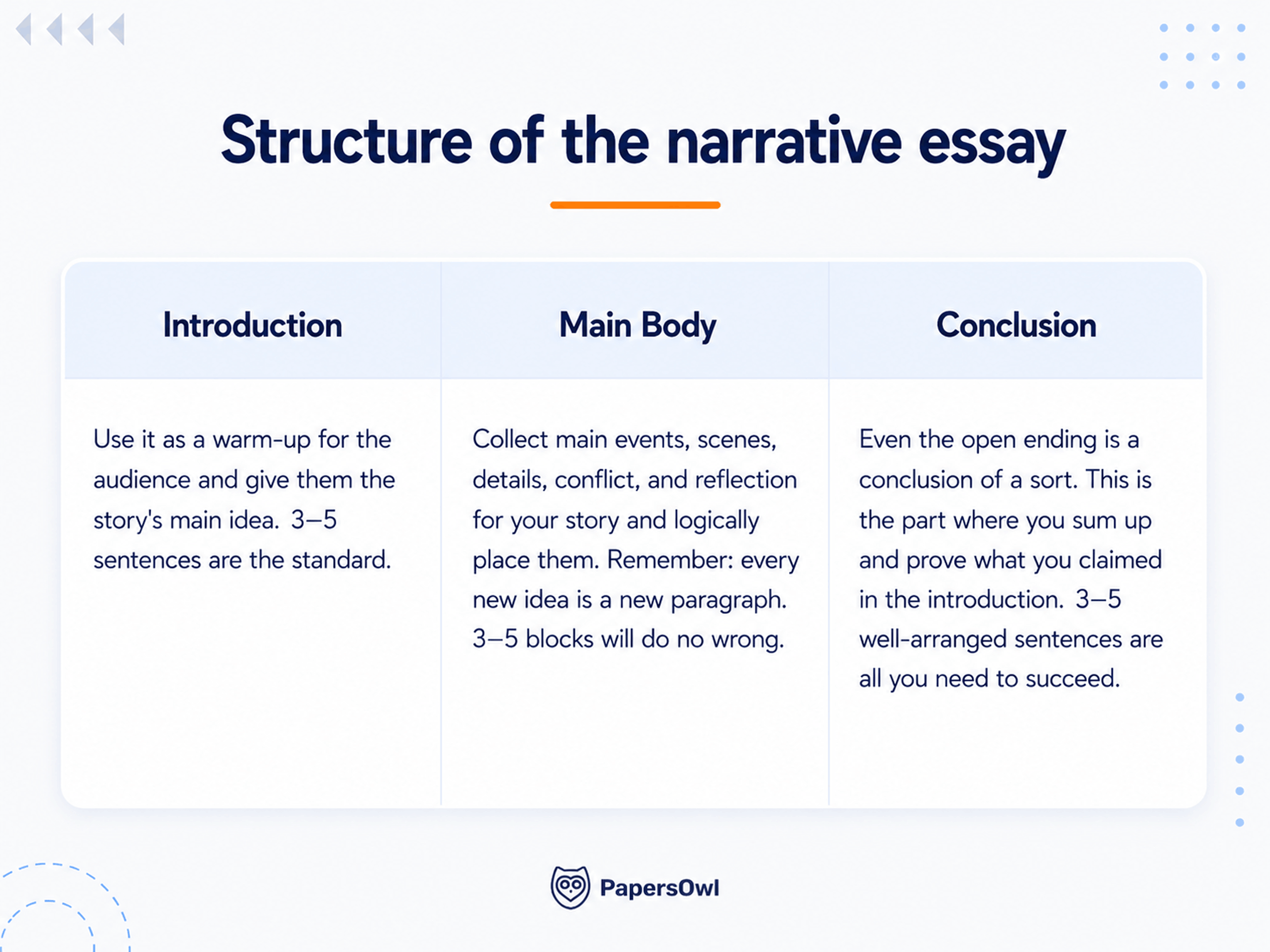
- Organization also matters. Most narratives have the following parts of a narrative essay: introduction, main events, turning point, and conclusion. It should be easy for readers to follow the story without getting lost.
- Reflection is what separates a narrative essay from just a story. Don’t just tell what happened. What did you learn? Why was the experience important to you?

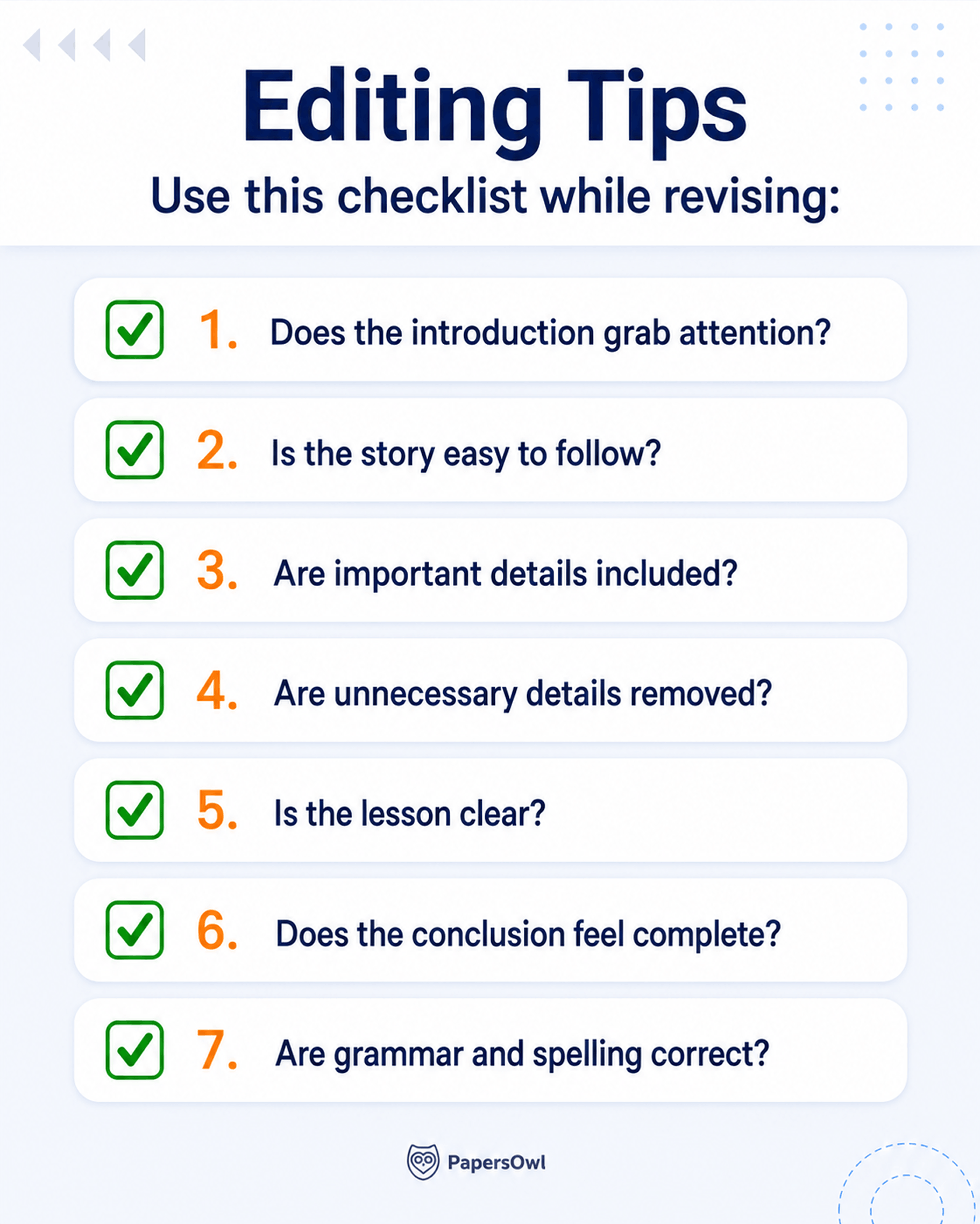
Before you submit, ask yourself:
If the answer is “yes” to these questions, you are on the right track!
9 Main Steps in the Narrative Essay Writing Process
Writing a good personal story rarely happens in one sitting. Most strong papers go through several stages before they are finished.
The process becomes much easier when you take it one step at a time. Instead of worrying about the entire assignment, focus on one task at a time.
Here are the steps to follow in the writing process, which will guide you on how to start a narrative essay successfully.
Before you begin: 2 things to check first
Before diving into the steps below, make sure you understand what your teacher expects. Check the word count, format, and task goal — some teachers want a simple story, others expect more reflection. If anything is unclear, ask right away instead of rewriting later.
It also helps to read a few examples first. Notice how they open with a small moment, build the story step by step, and end with a clear lesson. This gives you a sense of structure before you start planning your own.
Step 1: identify the story you want to tell
Begin by selecting one experience that had a clear effect on you. The best topics often focus on change, growth, challenges, mistakes, achievements, or important realizations.
Ask yourself a few simple questions:
- What experience do I remember clearly?
- What lesson did I learn?
- Why does this event still matter today?
- Can I describe it with enough detail?
For example, you could write about:
- Learning to ride a bicycle.
- Moving to a new city.
- Losing an important competition.
- Getting your first job.
- Making a difficult decision.
- Overcoming stage fright.
- Repairing a broken friendship.
A smaller event is often better than a huge life story. Rather than recounting your entire high school career, focus on one meaningful day or moment.
Step 2: create an outline
This is often skipped by many students. Then they find it hard to organize their ideas. An outline is like a road map. It helps you see where the story starts and ends.
A simple outline might be:
- Introduction – Introduce the situation and the lesson.
- Beginning – Set up the scene and give background.
- Rising Action – Summarize major events and create suspense.
- Climax – Show the crisis or the most important event.
- Conclusion – Think about the experience and the lesson learned.
Narrative essay outline examples:
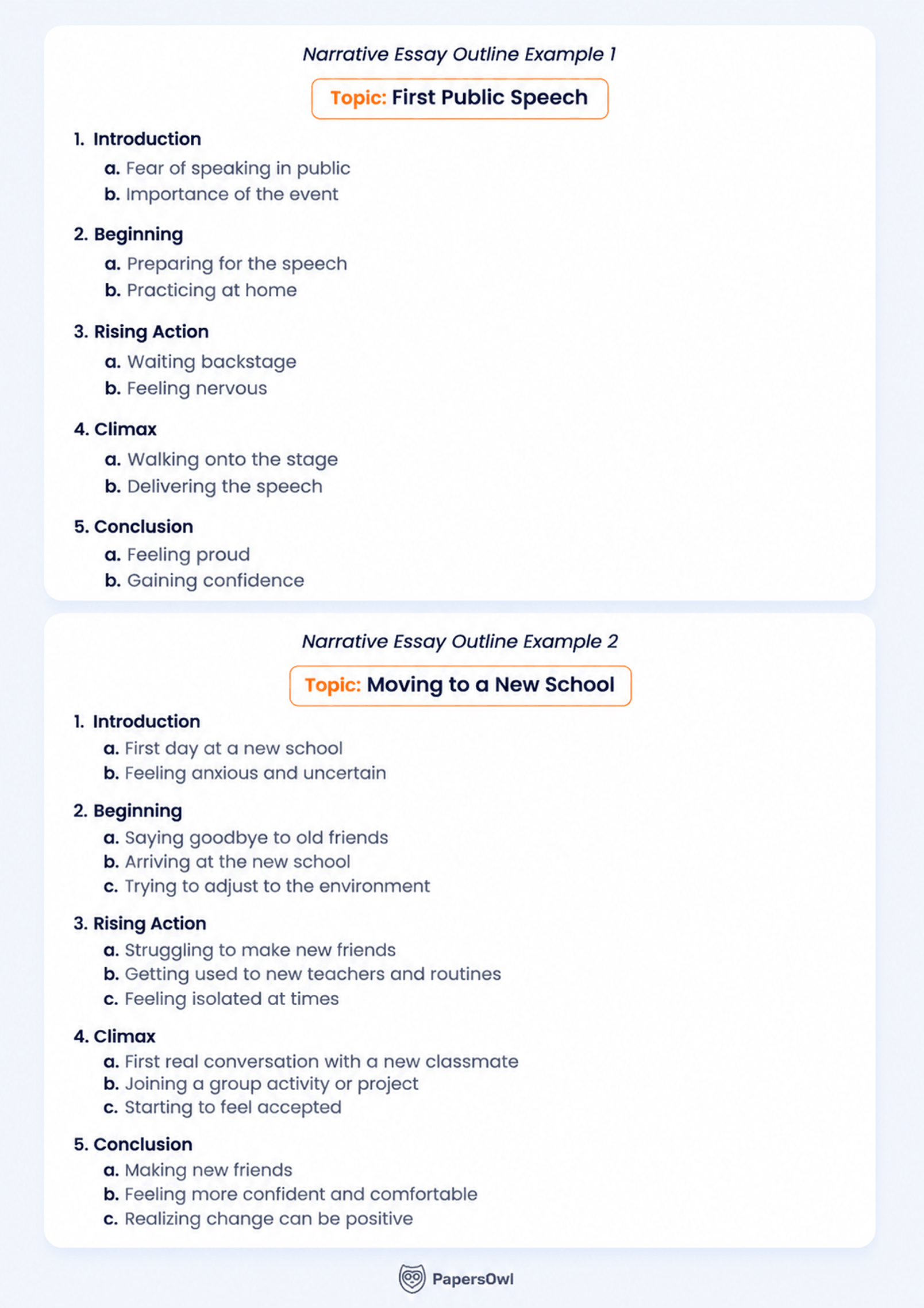
Keep your outline simple. You only need enough information to guide your writing.
Step 3: start writing the first draft
Now it’s time to tell the story. Don’t worry about perfection. Focus on getting your ideas onto the page.
Write in the first person using words like:
- I;
- Me;
- My;
- We.
Writing in the first person helps make your story more personal and engaging. Readers can relate to your experiences and see the story from your perspective.
Be sincere and open with your thoughts and feelings to help illustrate your point.
Step 4: build the story around important storyline elements
A few key parts always work together when you tell a story. These include plot, character, setting, theme, dialogue, and conflict. Each one makes your story feel real and interesting.
Let’s review these building blocks:
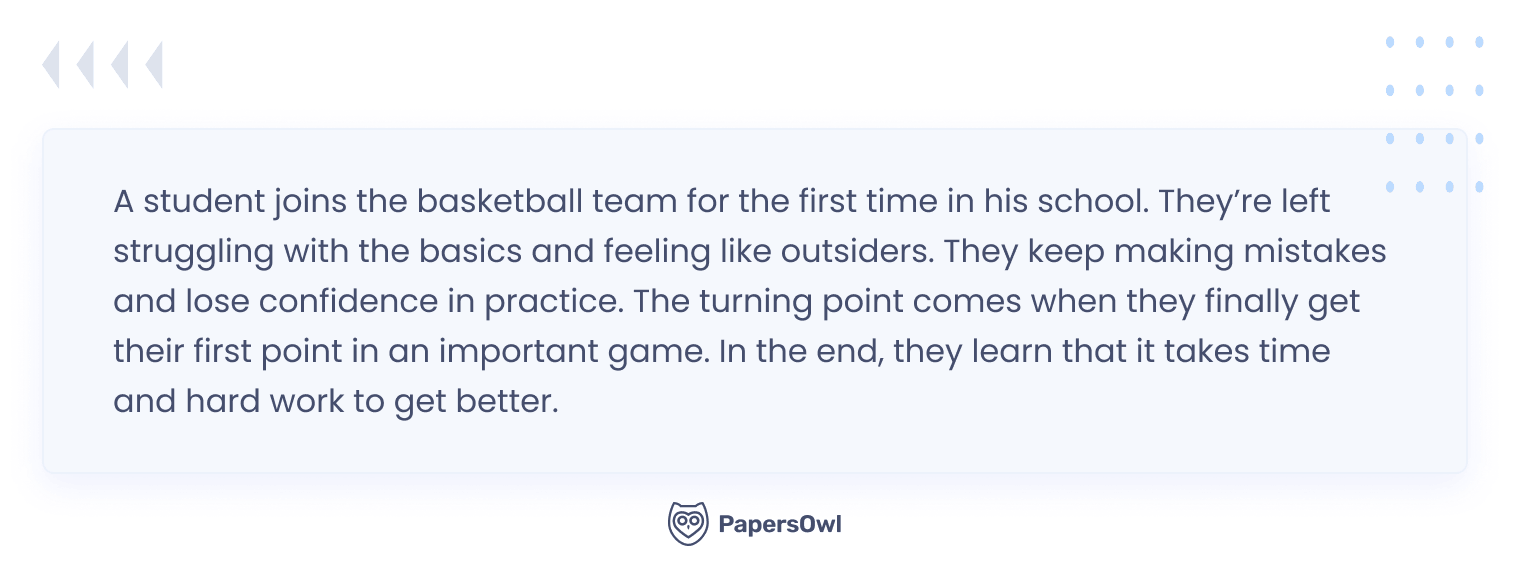
Plot
The foundation of any essay is a clear, organized plot.
Start with an engaging introduction that grabs attention, then build events toward a peak moment of tension or conflict, and finally resolve the story.
The plot must include a significant event or experience and must offer a lesson or insight for the reader.
Characters
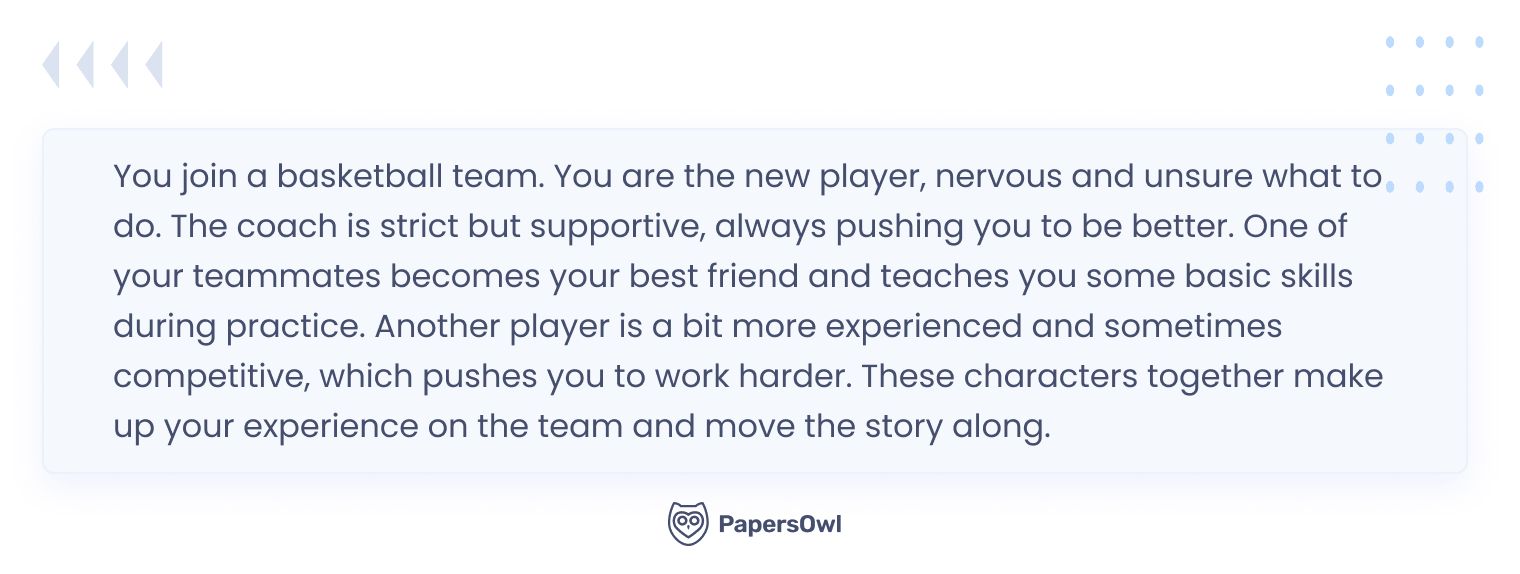
Characters are the people in your story. Most of the time, that’s you and the people around you:
- Friends;
- Parents;
- Teachers;
- Coaches;
- Classmates.
They should be authentic and have clear roles. Each character should have unique qualities that add depth and drive the story forward.
Setting
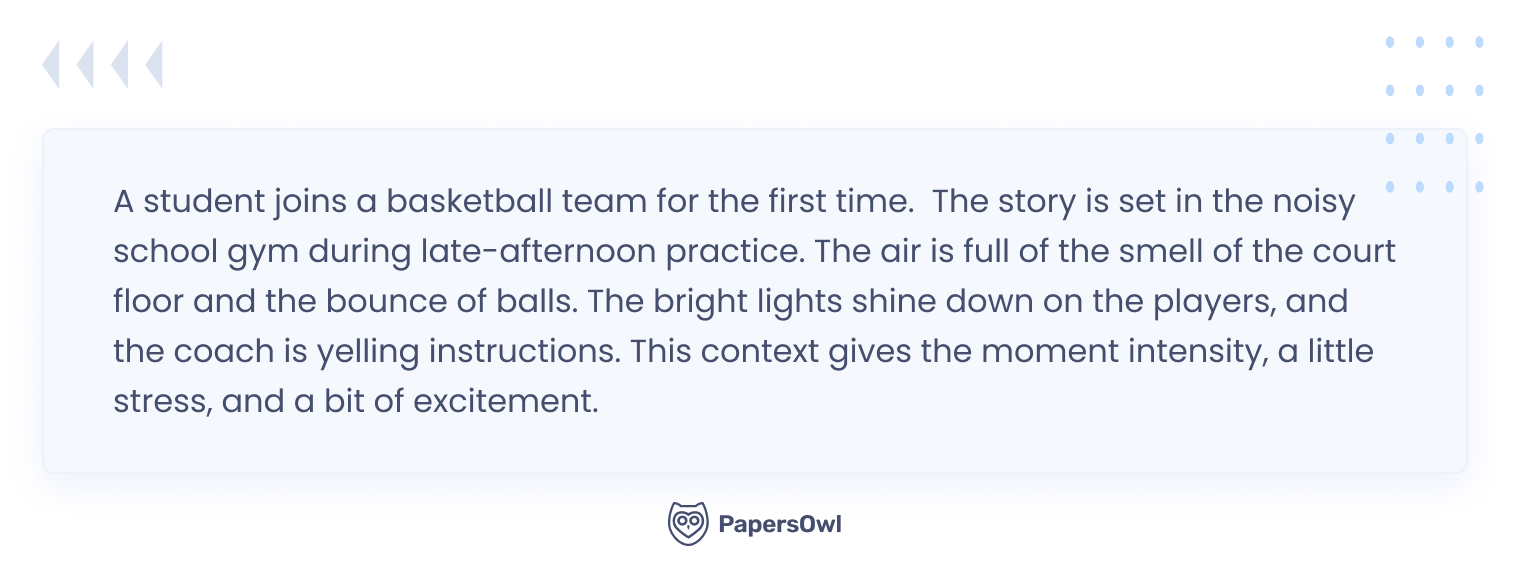
Setting is the place and time in which a story occurs. It helps us to see the moment. A good setting adds atmosphere and feeling.
Theme
The theme is the main idea or lesson of a story. It tells you what the experience actually is and why it matters. It ties all events together into one clear message for the reader.
Common themes include:
- Responsibility;
- Confidence;
- Trust;
- Perseverance;
- Friendship;
- Courage.

Dialogue
Dialogue is what characters talk to each other. It makes scenes more real and natural.
Employ dialogue sparingly and only where it adds value. Too much talking distracts the reader. So short dialogue often works best.

These small lines show support and help the scene feel more real.
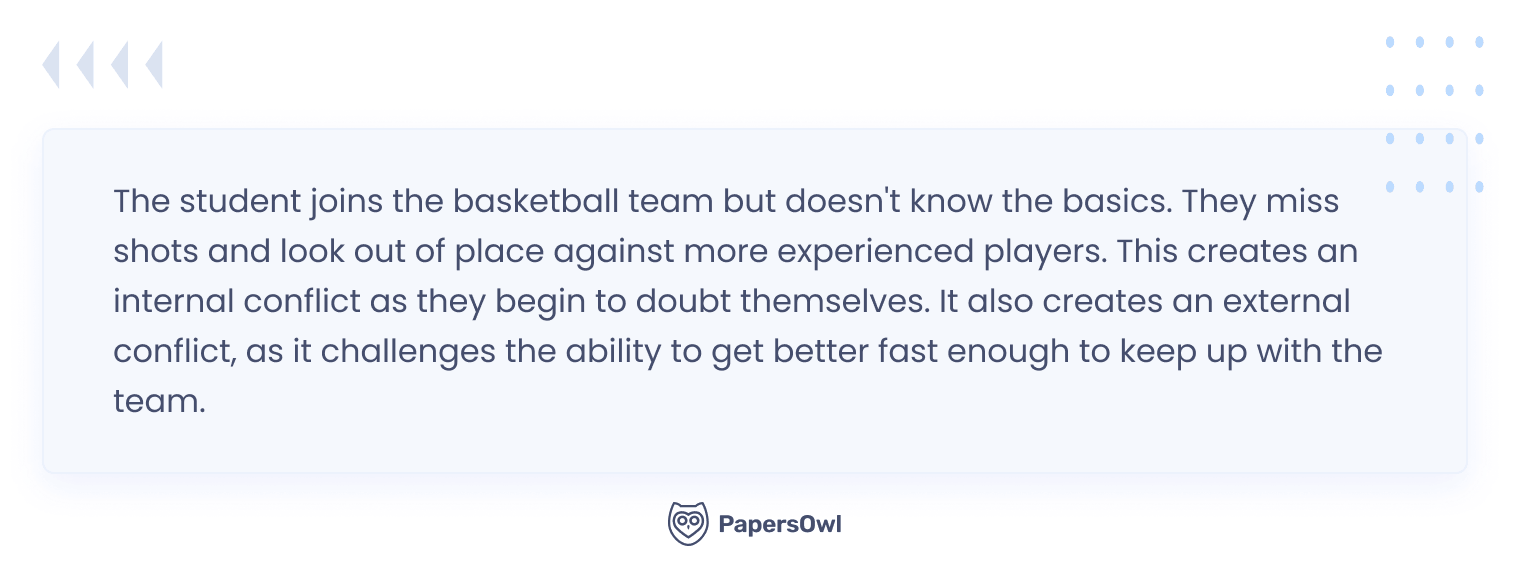
Conflict
The main challenge in the story is conflict. It builds tension, it makes things interesting. Without conflict, nothing really changes. There is no growth and no lesson learned.
Typical conflicts are:
- Fear;
- Failure;
- Disappointment;
- Misunderstanding;
- Competition;
- Difficult choices.
Step 5: keep events in order
Many personal stories follow chronological order, but a non-linear approach can also work if the timeline stays clear.
That means the events may happen in the order they happened, or they may include flashbacks, as long as readers can follow your ideas.
For example:
- You prepared for a competition.
- You participated.
- You received the result.
- You reflected on the experience.
Jumping back and forth between events can create confusion. Keep the timeline clear whenever possible.
Step 6: focus on important moments
One common mistake is including too many details. Not every event deserves attention.
Ask yourself: “Does this help tell the story?” If not, remove it.
For example, imagine you are writing about a soccer championship.
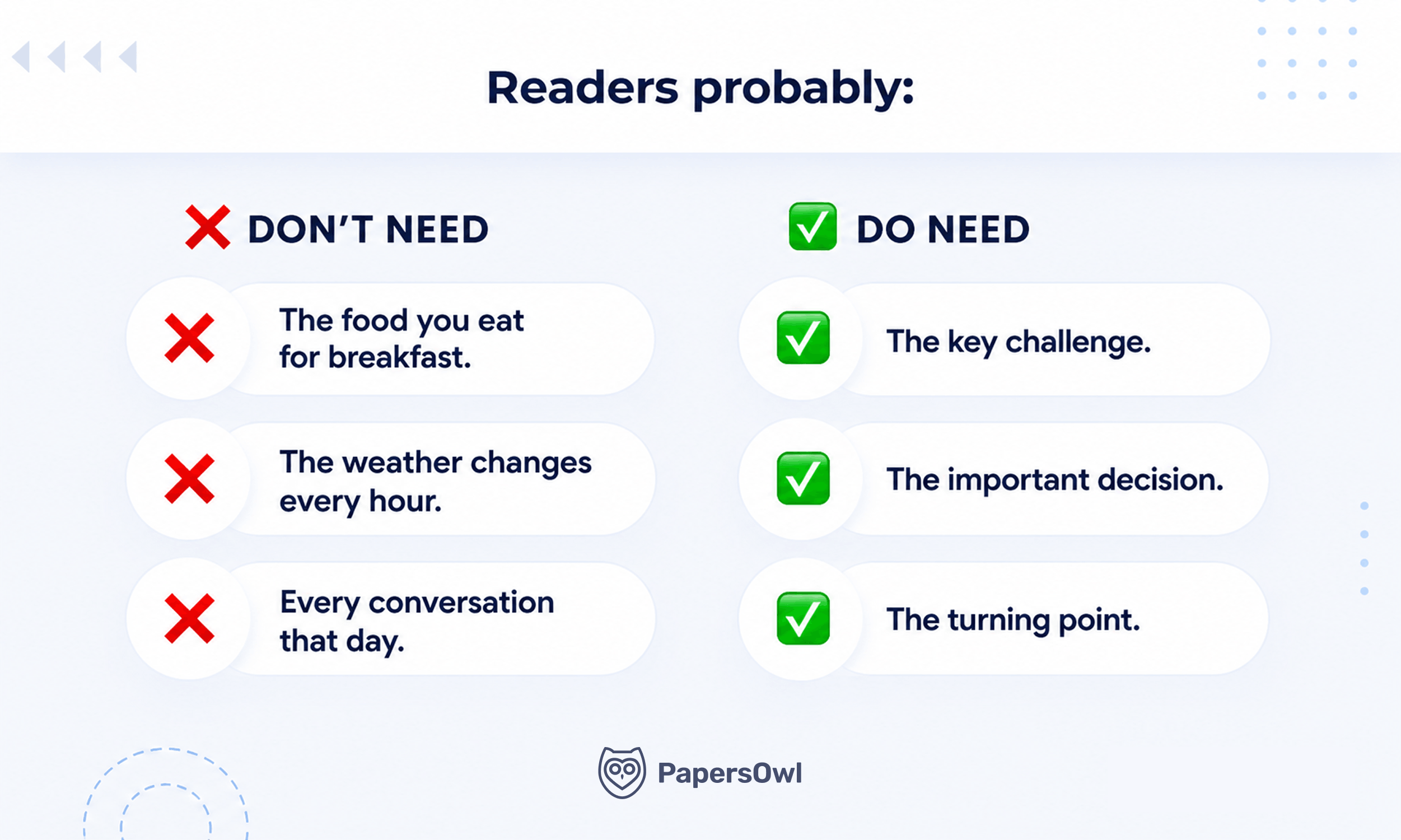
Focus on moments that move the story forward.
Step 7: add reflection
Reflection is often the most important part. It explains why the experience matters.
Many students spend pages describing events. Then they write one short sentence about the lesson. Do the opposite.
Spend time explaining:
- What you learned.
- How you changed.
- Why the experience mattered.
For example:
That reflection gives the story meaning.
Step 8: revise your draft
The first version of your narrative format example is rarely the best version. Good writing comes from revision.
After finishing, take a break. Then read everything again. Look for:
- Unclear sentences.
- Repeated ideas.
- Missing details.
- Grammar mistakes.
- Weak transitions.
Reading aloud helps a lot. That way, you will hear awkward sentences immediately.
Step 9: get feedback
Sometimes you become too familiar with your own writing. Ask someone else to read it. A friend, parent, teacher, or classmate may notice things you missed.
Ask questions like:
- Was anything confusing?
- Which part was most interesting?
- Did the lesson make sense?
Fresh feedback often improves the final version.
So, crafting a compelling narrative essay that effectively communicates your point and captivates the reader can be a valuable skill to acquire.
If you have some trouble with the process, you can always ask for help from an essay writer on papersowl.live. With their expertise and guidance, you can write a captivating text that gives your audience a peek into your unique experiences and insights.
How Long Is a Narrative Essay?
There are two simple things to keep in mind.
First, always follow your teacher’s instructions. Second, write as much as you need to tell the story clearly. No more, no less.
It should be a story long enough to show what happened and what you learned from it. If it’s too short, important information can be missed. If it’s too long, it can be repetitious and lack focus.
Length varies by assignment:
- Short tasks: 500–800 words.
- Regular school assignments: 800–1500 words.
- College-level work: 1500–2500 words.
For instance, a short essay about delivering the first speech may simply state the problem. A longer one could have some preparation, the moment on stage, feelings of nervousness, and the final reflection.
In the end, the right length is the one that communicates your experience and gets your message across.
How to Format a Narrative Essay?
The format should be professional and adhere to academic standards. If your assignment requires APA format, here are some key formatting rules:
- Use one of the APA 7th edition-approved fonts.
- Double-space your text.
- Maintain one-inch margins on all sides.
- Indent the beginning of each paragraph by half an inch.
- Do not add extra spacing between paragraphs.
- Include a cover page.
- Add a header with the page number.
The exact type of format you use will depend on your college or university. Some institutions have a set formatting style that all academic writing submissions must follow. Make sure to check and adhere to these specific guidelines.
Video Guide to Write a Personal Narrative Outline
If you want to know how to write a good personal narrative outline, we will explain the most important guidelines in this video:
Instead of a Conclusion
At its core, a narrative essay works when the story and the lesson behind it feel equally clear to the reader. Follow the steps above, keep your focus narrow, and the rest of the writing tends to fall into place.